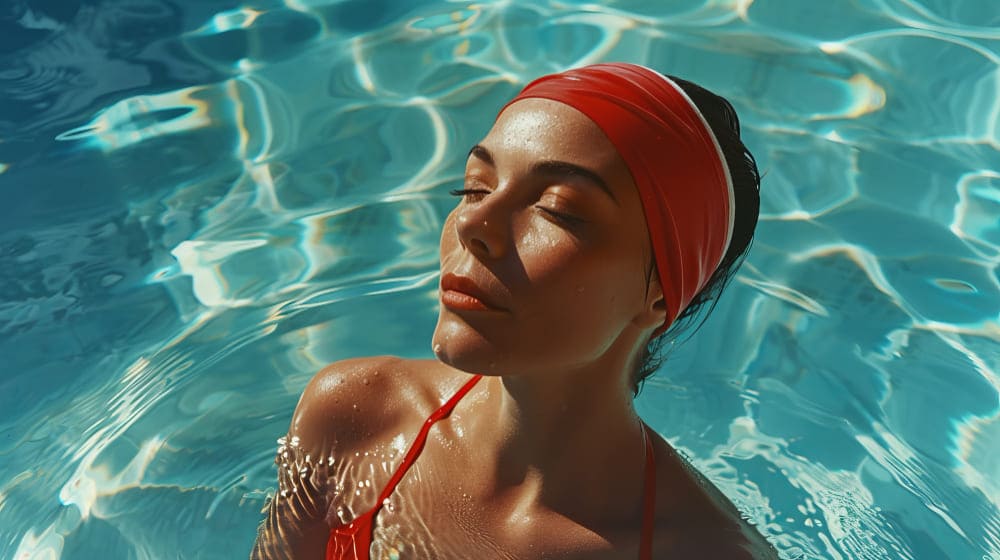
Swimming is one of the few forms of exercise that feels like a treat. Then you catch your reflection afterward and find your hair dry, rough and squeaking under your fingers. If you swim regularly, learning how to protect your hair from chlorine is worth a few minutes of preparation. The habits that make the real difference all happen before you get in the water.

What Chlorine Actually Does to Your Hair
Your hair has a natural oil coating called sebum that keeps moisture in and the outer layer smooth. Chlorine strips that coating. Underneath it sits the cuticle, a layer of overlapping cells a bit like roof shingles, and once the oil is gone the cuticle lifts and roughens. That is why pool hair feels coarse, tangles more easily and looks dull instead of shiny.
Being honest about what happens next matters, because a lot of advice online is not. Hair is not living tissue. Once the cuticle is damaged, no product rebuilds it. What good products do is fill the gaps, smooth the surface and hold moisture in, so the hair looks and behaves better while the damaged length grows out. That is a genuinely useful outcome. It is just not repair in the way the word suggests.
Damage is also cumulative. One afternoon in a pool is nothing. Three swims a week through a summer is a different matter, especially on hair that is colored, bleached or already dry.
How to Protect Your Hair from Chlorine Before You Swim
Almost everything you can do to limit damage happens in the five minutes before you get in. Hair behaves like a sponge, and a sponge that is already full of clean water has far less room to soak up anything else.
Soak Your Hair in Clean Water First
This is the single most effective habit on the list, and it is free. Stand under the shower until your hair is properly saturated, not just damp. Hair that is already full of tap water absorbs noticeably less pool water, which means less chlorine reaching the cuticle in the first place.
Use Conditioner or Oil as a Barrier
On wet hair, work a little conditioner or a light oil such as coconut or argan through the mid-lengths and ends and leave it in. It sits on the surface and takes the brunt of the chlorine instead of your hair doing so. Keep it off the scalp, use less than you think you need, and concentrate on the ends, which are the oldest and most porous part of your hair.
Leave-In Sprays
A leave-in spray does the same job in a lighter form and suits fine hair that goes limp under oil. Look for one with humectants such as glycerin. Spray it through damp hair, comb it so it is evenly distributed, and braid or clip the length up if you are not wearing a cap.
Swim Caps
A cap helps, but no cap keeps hair completely dry, so treat it as one layer rather than a solution. Silicone seals better than latex and is kinder to hair when you pull it off. The combination that works better is wet hair, conditioner or oil left in, then the cap over the top.
While You Are in the Water
Keep Long Sessions Occasional
Exposure adds up over time in the water, so a long training session costs your hair more than a quick swim. If you are in the pool most days, that is not a reason to stop. It is a reason to be consistent about the pre-swim routine and to build in a weekly conditioning treatment.
Rinse Between Swims
If you swim, sit out, then swim again, rinse your hair at the poolside tap in between. Chlorinated water drying on your hair in the sun is harsher than chlorinated water you rinse straight out.
After You Swim: Getting the Chlorine Out
Rinse Straight Away
Rinse with clean water before you do anything else, ideally before you leave the pool building. This costs thirty seconds and removes a large share of what is sitting on your hair.
Clarifying Shampoo and Chelating Shampoo Are Not the Same
This distinction is worth knowing, because it is the one most articles skip. A clarifying shampoo strips general buildup: product residue, oil, silicone. A chelating shampoo contains an ingredient such as EDTA that binds to metals and minerals and lifts them out. Pool water leaves both kinds of deposit, so if your hair feels coated and looks dull after weeks of swimming, a chelating formula does what a clarifying one cannot.
Either type is stripping by design. Use one once a week at most, follow it with a conditioner, and skip it entirely in the days right after a color service.
Deep Conditioning Treatments
A mask replaces the moisture chlorine strips out and smooths the cuticle so hair feels soft rather than squeaky. Apply it to clean, damp hair, leave it ten to fifteen minutes, and rinse thoroughly. Ingredients worth looking for include argan oil, keratin, aloe vera and glycerin. Once a week is plenty for most people, and there is more detail in our guide to how to moisturize your hair.
Leave-In Conditioner
A light leave-in on damp hair keeps moisture in through the day and makes combing easier. That matters, because wet, chlorine-roughened hair snaps more readily than dry hair.
Choosing the Right Conditioner for Swimmer’s Hair
Swimmer-Specific Formulas
Products labeled for swimmers usually pair a mild chelating agent with heavier conditioning, which is a sensible combination if you are in the pool several times a week. Read the ingredients rather than trusting the label, since “swim” on the bottle is a marketing decision, not a formulation standard.
Protein and Moisture Together
Chlorine-exposed hair typically needs both. Protein such as keratin or silk amino acids temporarily reinforces weakened areas along the strand, and moisture keeps it flexible. The balance matters: protein on its own, used too often, leaves hair stiff and prone to snapping. If your hair starts feeling brittle rather than strong, that is the signal to cut back on protein and add moisture.
Natural Oils
Coconut, argan and olive oil all smooth the cuticle and reduce moisture loss. Coconut oil is the one with the most evidence behind it for penetrating the hair rather than only coating it. Use oils sparingly, on the ends, and less often if your hair is fine.
If Your Hair Is Already Dry and Damaged
After a summer of swimming, the goal shifts from prevention to management. Make the existing length look and feel as good as it can while it grows out, and stop adding to the problem.
A protein treatment every week or two reinforces weak spots. A rich mask keeps the length soft between treatments. Oils on the ends buy you time before a trim. And a trim genuinely does help, not because cutting hair changes the rest of the strand, but because split ends travel upward and removing them stops the damage spreading.
If your hair is colored on top of chlorine exposure, a salon treatment is worth considering, since the two together are harder on hair than either alone. Our stylists can look at your hair and tell you what will help and what will not. You can see the full range on our salon services menu. For dullness, a gloss is often part of the answer, and we cover that in our guide to hair gloss and glaze.
Green Tint: It Is Not the Chlorine
Here is the correction worth making, because nearly everyone blames the wrong thing. Blonde hair does not turn green because of chlorine. It turns green because of copper in the water, which comes from copper-based algaecides and from corroding pipes. Copper binds to the keratin in your hair and oxidizes, and oxidized copper is green. Hair exposed to chlorinated water containing no copper does not turn green at all.
Chlorine still plays a part, but an indirect one. By roughening the cuticle, it opens the door for copper to lodge in the hair. Damaged hair then takes up substantially more copper than healthy hair does. If you want the underlying chemistry, this explanation of the copper reaction covers it clearly.
The practical upshot is that a purple shampoo will not fix it, because purple toner corrects yellow, not green. What lifts copper out is a chelating shampoo. Blondes and anyone with lightened hair should also know that a saltwater pool is not an escape route, since those systems generate chlorine from salt.
Swim Season Without the Aftermath
None of this needs to be complicated. Learning how to protect your hair from chlorine comes down to five habits:
- Soak your hair with clean water before you swim.
- Leave conditioner or a light oil in it as a barrier.
- Rinse the moment you get out.
- Use a chelating shampoo weekly rather than daily.
- Keep a conditioning mask in the shower.
Do those five things and you can swim as often as you like without the dry, dull hair that usually follows.
If your hair has already taken a summer of it, bring it in. Book a consultation at HairSocial in Tysons or Falls Church and we will tell you honestly what condition it is in and what is worth doing about it.

Jessica Colors
Jessica Colors writes about color, cutting and care for HairSocial, a salon with two Northern Virginia locations: Tysons Galleria and Idylwood Plaza in Falls Church. Her posts stick to the practical side of a service — what it involves, what it starts at, how long it holds and what it takes to keep it looking good between appointments. Anything specific to your own hair is better answered in person, and consultations are free at both locations.

Photo to Coloring
April 17, 2025 at 3:44 pm
Really appreciate this breakdown! I’ve noticed how dry my hair gets after regular swims and didn’t realize how much prep before hitting the pool can help. Curious if rinsing with fresh water before swimming helps reduce chlorine absorption too?